Trigonometry
The purpose of the mathematical field of trigonometry is to relate the side lengths of a triangle to its angles. The simplest way to do this is by using three functions on your calculator that determine what the ratio of two sides in a right triangle ought to be, given an angle in that triangle.
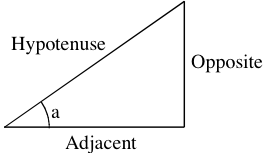
Suppose I have a right triangle, and I know one of the acute angles. Let's call that angle a. I label the Hypotenuse and the legs Opposite that angle and Adjacent to a. Asking my calculator for the sine, cosine, or tangent of the angle a will give ratios relating these three side lengths:sin(a) = Opposite / Hypotenuse
cos(a) = Adjacent / Hypotenuse
tan(a) = Opposite / Adjacent
You can remember this with the mneumonic SOH-CAH-TOA.
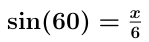
Using these ratios, I can set up an equation and solve for any unknown side. Suppose I know that the hypotenuse is 6 long, and the angle at the top right of the triangle is 60°. If I want to solve for the length (let's call it x) of the bottom side, I think, "That side is opposite my angle; so, sin(60) = x / 6, therefore x = 6sin(60) = 5.2 (by calculator)."- What is the length of the right side in the example I did above?
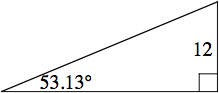
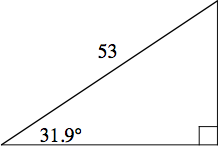
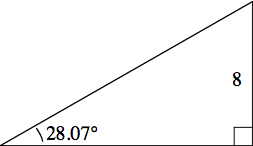
- For each of the triangles below, one side and an angle are given. Determine the length of all the other sides, by using trigonometry. Be sure to show how you are setting up the ratios to solve these problems.
I know the angles look weird and complicated with all those decimal points. But I've chosen angles like that so that the sides will come out to reasonable numbers, thus letting you know that you're on the right track.
Always check to make sure that your lengths agree with how long the sides appear to be. It's easy to accidentally reverse the legs.
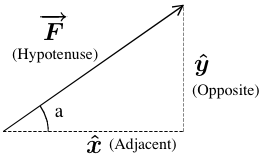
What we will be using trigonometry for is to "resolve" a force into components. That is, given the strength of a force  and the angle
 a, we want to be able to find the  +
+  form of the force. As you can see, the and just form the sides of a triangle for which is the hypotenuse. So, we can solve for the components usign trig.
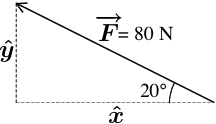
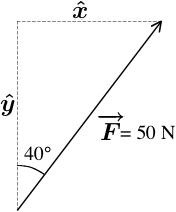
- In the examples below, find the + form of the force vector. Think carefully about whether each component should be positive or negative.
- A rope is pulling toward the southeast at an angle 30° away from south. The tension in the rope is 100 N. Draw this situation, and find the vector form of the tension force.