Friction
Any time I try to slide an object across some surface, there will be a friction force opposing this motion, pushing back in the opposite direction. If there is enough friction, it can stop an object from moving entirely; pushing on a parked car, for example, is unlikely to move it. So, like the normal force, friction will grow as big as it needs to be to stop motion from happening.
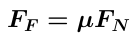
What makes the friction force different, however, is that it has a maximum strength. At some point, it can't push back any harder, and it will let the object move (though still pushing back on it with all its strength). The maximum strength of friction depends on the normal force (which tells us how much the two surfaces are being pushed together) and on a number called the "coefficient of friction," represented by the Greek letter μ (mu), that says how sticky the surface is.
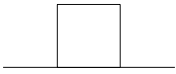
The mu value depends greatly on the types of materials that are in contact, and whethere they are dry or wet, oiled or not, and so on. It is something that can only be determined by an experiment. In some cases, there is one value μk for when the two surfaces are sliding past each other ("kinetic"), and an entirely different value, μs, for when the two surfaces have not yet begun to slide ("static").- A crate is sitting on the floor. You push it toward the left; call this force Fa, meaning "applied force." Friction stops the box from moving.
a) Draw the force diagram. (There are 4 force vectors)
b) The coefficient of static friction of the crate in the first problem is .4, and its weight is 50 N. How much force do you need to push with to get the crate to start moving?
c) Once the crate is moving, you find that it only takes a force of 15 N to keep it moving at the same speed. What is the coefficient of kinetic friction?
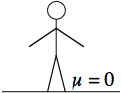
- A person is standing on a floor whose coefficient of friction is exactly 0. Can he move horizontally? What will happen to him?
- I am pushing a crate across the floor toward the right, exerting a force of 150 N. The crate has a mass of 50 kg and a μk of .5.
a) Draw a force diagram for this situation, and find the strength of each force.
b) Is the crate speeding up, slowing down, or moving at a constant speed?
c) What is its acceleration?
d) Suppose I were to increase my applied force to 300 N. What would the acceleration vector be then?
- People will sometimes load sandbags into the back of a car to make that car safer to drive in the snow. Why does this work? (What physics quantity is changed by adding sandbags?)
- In really rough climates, people also have "snow-chains" that they can put on their wheels to make them grip the road better. Why does this change the friction force?
Answers: 1) b) 20 N c) .3 2) He can't move. Or more precisely, he can jump or fall down, but he can't move horizontally at all. The friction force from the ground is what lets us walk; this is like being on really slippery ice. 3) c) -2 m/s² d) 1 m/s² 4) FN 5) μ