Inertia
Our next unit in physics is about force. A force, in physics terms, means pushing or pulling on something; the bigger the push, the stronger the force. Force is a way to change motion, so it is closely releated to acceleration.
Before we learn about force, we want to introduce the thing that opposes force: inertia. The more mass an object has, the more it resists any attempt to acccelerate it; this property of objects is called inertia. If an object is really massive, has a lot of inertia, it can't change its motion quickly without a really big force.
At the center of the force unit are the three laws that Newton came up with to describe motion. We learned in class today Newton's first law: All objects at rest will remain at rest, and any object moving in a straight line will keep moving in a straight line, unless some force acts on it that is not balanced out by an equal force in the other direction. This means that any time you see the motion of an object changing (slowing down, speeding up, changing direction), this is the result of some sort of force.- A bowling ball has a mass of 3 kg and is rolling across the floor at 4 m/s. How much force is required to keep it going at this speed?
- Show below is a position graph of a collision between two objects. Which had the greater inertia (shows more resistance to change in its motion)?
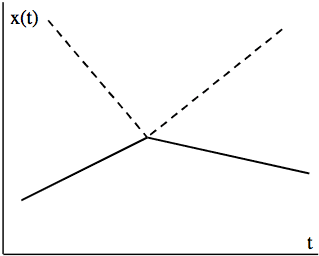
- Who will find it easier to change direction: a heavy football player, or a light track runner?
- Suppose that a fly collides with the windshield of a truck. Which of the two will probably experience a greater change in their motion?
- If an object is hanging from a rubber band, and you pull the object down a little bit, it will bounce up and down. A more massive object will bounce more slowly, although it goes the same distance. Why is it slower?
- We know from our study of motion that all object fall at the same rate. So, for example, if I throw a bowling ball and a baseball with the same initial velocity, they will travel along exactly the same path through the air.
a) Keeping in mind that the velocity required for each is exactly the same, is it easier to throw a bowling ball, or to throw a baseball the same distance? Or are they both the same?
b) Why is it so hard to throw a ping-pong ball any appreciable distance?
- For the following situations, state whether or not there is a net force acting on the object ("yes" or "no").
- A rock is sitting on the ground.
- A car speeds up as it gets on the highway.
- A car is moving along at a constant speed.
- The knot in the middle of a tug-of-war rope is not moving.
- A coin is in free fall.
- A car maintains a constant speed while turning a corner.