Force

Table of Contents

1. Pushing an object, exerting a "force," makes it accelerate

1.1. Objects do not change their motion without being pushed

When we see an object moving, our natural assumption is that something is pushing it. Even very young children are able to recognize objects that are "animate" and are surprised when some "inanimate" object moves on its own.

Greek philosophy expressed this idea by saying that the "natural" state of any object is to be resting on the ground, unmoving, and that in order for anyhting else to happen, the object must have some "force" acting on it. So, for example, when a car runs out of gas, it returns to its natural state of not moving.

However, there are some things wrong with the idea that motion requires a force to keep it going. For example:Galileo, who you have doubtless heard of in your other science classes, answered these questions with a surprising idea: the natural thing for an object to do is not to slow to a stop, but rather to keep on moving exactly the way it starts out moving. Objects slow to a stop not because there is nothing pushing them forward, but because there is something, namely friction, that is pushing against them, slowing them down. If there were no friction, the object would roll forever.

You could think about it this way: If I make a ramp like a half-pipe, and I release a marble from one side, it will roll until it reaches the same height on the other side. No matter how far away the other side is, it should rise to this same height. So, if there is no other side to the ramp, the marble will just keep rolling forever.

Newton, one of the most important men in physics, formalized this when he wrote his laws of motion, which are the basis for all the physics we will study this term. Newton's first law says that:
An object at rest will remain at rest, and an object in motion will keep moving at the same speed in a straight line, unless it is acted on by some force.

Newton said this all in Latin, which was the language of science in his time, and since you all know Latin I can show you how he originally phrased it:
Corpus omne perseverare in statu suo quiscendi vel movendi uniformiter in directum, nisi quatenus a viribus impressis cogitur statum illum mutare.
cogo, cogere, coegi, coactum - (cum - ago) to bring together, drive, collect; restrict, compel
nisi quatenus - except in so far as; unless

What this means to us, as physicists, is that:
  1. If we see somthing at rest, or moving with constant velocity, we know that there is no force acting on it. Or, perhaps more accurately, we know that any force acting on it is balanced out by some other force; the car's engine provides enough force to balance the friction from air and the road.
  2. If we see something that is accelerating, if we see any change in the motion of an object (speeding up, slowing down, or even changing direction), then we know that somethign is pushing that object.

1.2. An object's mass gives it "inertia", a resistance to attempts to accelerate it

One thing that makes force harder to think about than acceleration is that the effect produced by pushing an object with a certain amount of strength will be different depending on the object. The amount of force that can slowly accelerate a heavy cart can send an unladen chair skittering quickly across the floor; that same amount of force, on the other hand, would barely budge a car.

What is different here between the various objects is how massive they are, or, in physics terms, how much inertia they have. "Inertia" is a word that means resistance to change in motion; you may have heard it used to describe the difficulty of a large company moving quickly into a promising new field of research. In physics, inertia just means how reluctant an object is to be accelerated, and in most normal situations, the mass of an object is equal to its inertia.

There are very many example of real-life situations where I can see or use this tendency of obejcts to not want to change their motion.
Homework: Inertia (pdf) (Due: 11/8/06)

1.3. Newton's second law tells us how force, mass, and acceleration are related

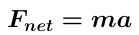
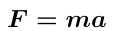
We saw yesterday that the more mass an object has, the less some force will accelerate it. This is Newton's second law. I won't inflict the Latin on you, since it's just a long an awkward way of saying something that methematical language expresses much more concisely:
Unlike the rate of change equations that were our primary toopls in linear motion, this equation isn't talking about a process (add my velocity to my position each second). Instead, it is expressing a relationship between three variables: mass (m), force (F), and acceleration (a).

I can immediately learn some thing from this relationship. For example, I know that the units of force have to be what I get when I multiply together the units of mass and those of acceleration: kg m/s². To save ourselves the trouble of writing this out every time I record a force measurement, we call this combination of units a "Newton", or N for short. A Newton is about a quarter pound, the weight of two eggs or a stick of butter.

The other key idea to understand is what this relationship tells me about how change in one of the three variables will affect another. For example, I can immediately see that if I increase the mass of an object, the force needed to accelerate it by the same amount will increase. I can solve for a = F / m, which tells me that the more force I exert, the more the object will accelerate, and if I keep the force constant, a more massive object will accelerate less.

In general, any two variables in an equation are either proportional to each other, meaning that an increase in one causes an increase in the other, or inversely proportional, meaning that an increase in either is connected to a decrease in the other. If I have solved an equation for any one variable, those variables that are in the numerator on the other side are proportional to it, and those in the denominator are inversely proportional.

So, for example, the equation to the right expresses the fact that a person's productivity tends to grow if they have higher intrinsic motivation, but it also tends to grow when they realize that they are approaching a deadline. Time is inversely proportional to productivity; motivation is directly proportional.

Mathematically, then, Newton's second law is just an expression of what we know about inertia: that inertia characterizes how hard it is for a force to cause acceleration in an object.

Activity: Second Law Cart (11/8/06)
(It takes force to start and stop a cart loaded with books. This activity allows us to investigate the relationship between force, mass, and acceleration)


Homework: Newton's Second Law (pdf) (Due: 11/9/06)

1.4. If an object is not accelerating, the forces on it in each direction balance

It is possible for an object to have several forces acting on an object, and yet for the object not to be accelerating. For example, when two teams are playing tug-o'-war, they are both exerting a lot of force, but if they are well matched, both teams are straining as hard as they can and no one is moving at all. We say that the two forces are balanced; one team could be exerting a force of 100 N (that is, 100 N, to the right), and the other team could be exerting a force to the left of -100 N, canceling them out.
If I write all the forces acting on an object as vectors, the sum of all those vectors is called the net force. Only the net force matters when trying to calculate acceleration; if there is no net force, the forces on the object are balanced and there is no change in the motion of the object.

Conversely, if I know the acceleration of an object, I know what all the forces must add up to. In particular, if an object is not moving or is moving at a constant rate, I know that the forces acting on it all cancel each other out. I can use this to determine what some of the forces are if I have been unable to measure them.

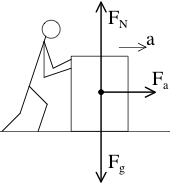
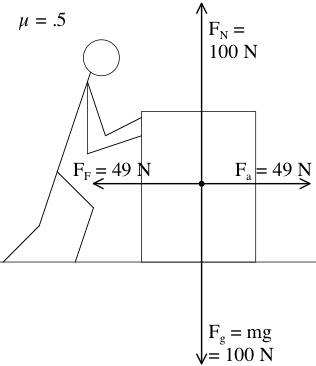
We represent the forces on an object by drawing a force diagram like that shown to the right. Here, weight (the force of gravity) is pulling the object down, but this is canceled out by a normal force, the force any surface exerts to keep other objects from going through it. A person is then exerting an applied force to the right; this force is not balanced out by anything, so the crate will accelerate toward the right.

We label all the different forces with an "F" to say that this vector is showing a force, then a subscript to say what sort fo force it is: g for gravity, a for "applied" force (a push), and N for the normal force.

1.5. An object's weight is the force exerted on it by gravity

One force that will always be present, for any object on Earth, is the force of gravity, better known as the weight of the object. We know already that
  1. All objects in free fall are being acted on only by gravity, and that
  2. All such objects accelerate at a rate g = -9.8 m/s² that says how strong gravity is on Earth, and that
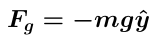
  3. The force acting on an object is its mass times the acceleration (F = ma), so it should come as no surprise that
So, you can almost always find out this one force, the weight, provided that you know the mass of the object. Or, if you can find out the weight, you know the mass as well. Gravity is the most reliable sort of force for us to deal with; it always has a set strenght and points straight down.

1.6. An object resting on a surface is supported by a "normal" force balancing its weight

A very common situation to see is something like a chair sitting on the ground and not moving. Obviously the forces on the chair must balance. If we are going to accept the fact that the gravity force is always acting on the chair, what sort of force is keeping it from being pulled into the center of the earth?

Obviously, what keeps the chair from moving is the fact that solid objects, like it an the floor, can't go through each other. We say that the floor exerts a type of force called a normal force upwards on the chair, balancing out the pull that would take the chair through the floor. Normal" just means "perpendicular" in math terms - the normal force always points straight out of a surface.

The normal force is really what you are feeling when your feet hurt after a long walk: your feet are constantly being pushed up by the ground to balance out your gravity force. The normal force is also what you are measuring when you step on a bathroom scale: the scale measures how much force it needs to use to hold you up.

The strength of the normal force can vary. Being a "lazy" force, it will always be just enough to keep the two surfaces from going through each other, and no more. So, for example, if I am carrying more weight, I will feel more force pressing on my feet. If I grab a tree branch above my head and pull upwards, I will gradually feel the force on my feet diminish and more and more of my weight is supported on my arms; when I am about to lift off the ground there is no longer any normal force on my feet because my arms are pulling up enough to balance my full weight.

Activity: Force Lab (pdf) (10 pts, 11/9/06)
(Forces only in the vertical direction. Recognize that the tension force from the scale, or the normal force from the balance, is balancing out the weight of the object, the force of gravity. Recognize that changing one force will change the others so that they still balance, and that gravity is fixed.)


Homework: Force Diagrams (pdf) (Due: 11/13/06)

1.7. If I try to slide an object along a surface, a friction force resists this

The last important force type that we will talk about is friction. You will remember that we started off this unit by saying that Galileo decided that a cart that is not being pushed will slow to a stop not because it can't keep going without a force actively pushing it, but rather because there is a force slowing it down, namely, friction.

Friction is probably the most complicated type of force. There are several things you should know about it:

*Friction is a force that exists wherever two surfaces are trying to slide past each other.* It will always act in such a way as to try to oppose that movement. So, when I start pushing a box across the floor, at first friction will try to keep it from moving at all, but once I get it moving, friction will still be there trying to slow it down.

*The more the surfaces are pressed together, the more friction there is.* You can try this out with your hands: if you just touch your hands together, it is easy to slide them past each other, but if you really press them together it becomes more and more difficult. In physics terms, we would say that the bigger the normal force is between two surfaces, the more friction there will be.

The amount of friction also depends on how smooth the surface is. You've probably noticed how much easier it is to push furniture over certain surfaces rather than others. We say that friction also depends on the stickiness of the surface, a quality that in physics we assign a number to and call μ (the Greek letter "mu"). If you want a more scientific term than "stickiness", you can call μ the "coefficient of friction." The μ can be any number from 0 to 1, where 0 would mean no friction whatsoever and 1 would mean that it would be just as easy to pick up the object as to carry it. Good automobile tires can grip the road with a μ as big as .85, and joints in the human body can be as smooth as a μ of .001.

The equation relating all these things is shown off to the left: the Force of friction between two surfaces is their μ multiplied by the normal force pressing them together.

Really, however, this only gives a maximum value for μ. Like the normal force, friction is lazy; if it can exert less than that and still keep the object from moving, it will. Unlike the normal force, friction hits a limit where it can't push any more, and it will give up and let the object start moving.

So, for example, in the situation above, I am pushing a crate which has a mass of 10 kg, and therefore a weight of 100 N. The normal force will be exactly strong enough to keep the crate from falling through the ground, so it will be exactly 100 N, to balance gravity. The μ of the crate is .5, so the maximum strenght of the friction force is μFN = 50 N.

I am only exerting 49 N of "applied" force toward the right. Normally, this would be a net force, and the crate would accelerate; in this situation, however, friction is present, so it will try to oppose that motion by pushign off to the left. Friction can grow as big as 50 N, but in this case only 49 N is needed to oppose my force and keep the crate from moving, so friction, being lazy, will be exactly that strong.

Now suppose a mouse were to come along and push with an additional force of 2 N, so that together we are exerting 51 N of force on the crate. Now friction is unable to cope, and it will max out at 50 N, leaving one newton of force to accelerate the crate to the left (albeit very slowly).

Often it happens that the friction force actually becomes less once the object starts moving, because it gets somewhat stuck in place when it stands still and once that initial resistance is overcome, sliding it along becomes easier. In a situation like this, we say that the surface has two different coefficients of friction: μs, where the "s" stands for "static", for objects that are not moving, and μk (for "kinetic") when the object is moving.

The difference between static and kinetic friction is why you will often lurch forward briefly when you first get an object moving. It happens because when the object stands still, it has time to form bonds with the surface it is on. The static friction will always be more than the kinetic friction.

Material
glass-glass0.90.4
metal-metal.6.4
greased metal.1.05
So, for example, when two glass surfaces are in contact, there is coefficient of friction of .9, almost as strong as is possible. Once you get them to start sliding, however, this coefficient will drop to .4, meaning that the friction force will be very markedly less. A similar, but less dramatic thing happens when metal is in contact with metal. If the point of contact is lubricated, both the static and kinetic friction are reduced dramatically; this is why any machine with moving parts needs to be oiled or greased.

Activity: Friction Lab (pdf) (10 pts, 11/13/06)
(Find the μ, the coefficient of friction, for a block sliding along a table, by weighing it down with different amounts of weight and determining the normal and friction forces)


Homework: Friction (pdf) (Due: 11/14/06)

2. A force at an angle can be "resolved" into components using trig

2.1. The trigonometric functions relate a triangle's side lengths to its angles

We know now that the forces acting on an object are all vectors, and that when added as vectors, the result is the net force. So, if we can measure the strengh and direction of the forces acting on any object, we should be able to draw a force diagram and find the net force.

Once we start using vectors in "real life" problems, you will find that we rarely know the + form of a vector. Instead, we typically know the length of the vector, and what direction it points in. So for example, in a plane, I can know that I am going NE at 71 m/s; I am unlikey to have a speedometer that reads this out as (50 + 50) m/s.
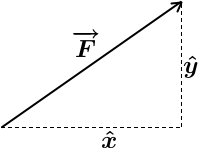
So, the problem we are trying to deal with is basically this: We know the length of a vector, shown here as the hypotenuse of a right triangle, and the angles of the triangle. We know from geometry that if we know any side of a triangle and we know the angles of the triangle, there is only one possible shape that that triangle can have. Therefore, there must be some way to figure out the length of the sides, the and components of .

In order to do this, we will use the field of mathematics called trigonometry. Trigonometry, as the name implies, is about measuring the sides and angles of a triangle. Of particular interest to us are three functions that your calculator knows how to calculate, called sin(), cos(), and tan(). These functions allow us to find out the ratio between any two sides in a right triangle, given that we know the angles of the triangle.
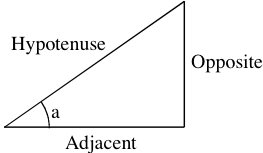
If we consider an angle a in a right triangle, and label the three sides as the Hypotenuse, the side Opposite the angle a, and the side Adjacent to it, then:You can remember these ratios with the mneumonic SOH-CAH-TOA.

So how do I use these ratios? Suppose that I know that = 6 N, and that this force is at an angle of 30°. In order to add it to other forces, I have to find its and component form. So, I have a triangle where the Hypotenuse is 6 long, one angle is 30°, and I want to find the y, which is Opposite that angle, and the x, which is Adjacent to it. I simply write down the facts that I know about the trig ratios:


So, my force vector is = (5.2 + 3) N. As you can see, all that I need to do to solve for any side in the triangle, given a side I know, is to write an equation representing the fact that "sine is the ratio of opposite to hypotenuse" or whatever, and solve that equation.

In practice, you can always get away without using tan(), so if you want, you can just forget for now that it exists.
Homework: Trigonometry (pdf) (Due: 11/16/06)

2.2. Trig can be used to take a force at an angle and "resolve" it into components

In a lab, you can measure the strength of a force easily enough. For example, a spring scale connected to a string tells you the amount of tension force in that string. What is a bit more tricky is to measure the angle of the force; this is tricky because we have to measure the angle relative to the horizontal or vertical direction, not relative to any string.

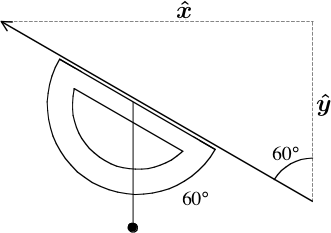
In order to measure the angle of a rope or string, we use a protractor with, attached to the center of it, a weight on a string (this is technically called a "plumb bob"). The weight will hang straight down. Therefore, if I line up the bottom of the protractor with a string, the angle measured on the protractor is the angle between the string and the vertical direction.

So, for example, suppose that I have a string with a spring scale on it, and the scale is reading 40 N. The string goes off toward the left an up, as shown to the right, so I know that the is positive and the is negative. I will measure the angle by holding a protractor near the string; this tells me that the angle between the force and vertical is 60°.

I draw a triangle of dotted lines, showing the amd components. I draw this triangle above the vector, so that it will include the angle I just found. Then, I just need to do a bit of trig to find the missing sides:


So, my force vector is = (-34.6 + 20) N. Notice that I have made the negative, because the vector goes toward the left.

If there were other forces acting on the object, I could do the same procedure to resolve them into components. Then, once everything is in component form, I can breathe a sigh of relief and stop worrying about trig and angles, because component-form vectors are much easier to deal with. In the above problem, for example, if the only other forces acting on the object were a horizontal force from another string and a downward force from gravity, then I could say with certainty that the gravity force is = -20 N (a mass of 2 kg) and that = 34.6 N is the other tension force.

Activity: Components Lab (pdf) (10 pts, 11/15/06)
(Three strings are all tied to a button, then each is connected to a spring scale. If you hold one string horizontal, one vertical, and the other an an angle, you should see that the forces on the horizontal and vertical scales are the and components, respectively, of the angled force.)


Homework: Resolving Components (pdf) (Due: 11/17/06)

2.3. Force needs to balance in both components for an object to not accelerate

Suppose that I know that all the forces on an object are balanced, because it is not accelerating. If that is true, all the vectors of the forces mut add to zero; in both the and the direction, the forces balance.

In a situation where we know the forces will balance, we don't have to be restricted to just finding forces, resolving into components, and adding up to find the net force. Instead, as we did with force diagrams before, we can solve to find any unknown force.

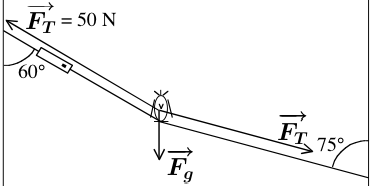
So, for example, consider the situation above. I have a wire stretched between two trees, with a spring scale near one end of the wire. A bird lands on the wire, causing it to bend slightly. I can measure the angle of the wire where it touches each tree, and I can see that the force in the upper part of the wire is 50 N. I want to find the mass of the bird.

I can quickly use trigonometry to find out the the upper part of the wire exerts a tension force of = (-43.3 + 25). I know that is straight down, only in the component. So, the component I just found must be balanced by the of the other force; it should be 43.3.



Now, I can use trig ratios again to find out how strong the other force is, and then what its y component is:
So, my other force vector is = (43.3 - 11.6) N. Assuming that the bird is not accelerating, I know that all the forces should add up to zero:

+ + = 0
-43.3 + 25 + 43.3 - 11.6 + = 0
14.4 + = 0
= -14.4

The bird has a weight of 14.4 N, which means it has a mass of about 14.4 / 9.8 = 1.47 kg, a very heavy bird.

Activity: Tension Lab (pdf) (10 pts, 11/16/06)
(Given a situation in which a weight is suspended by strings at many different angles, determine the angle of each string, then rsolve each force into components, and verify that the forces balance)


Homework: Balancing Forces 1 (pdf) (Due: 11/20/06)

One situation that is complicated enough to bear special attention is what happens to the friction force when there is some angled tension pulling on an object. You should remember that the friction force has strength FF = μFn. We have talked much about how differences in the surface changes the stickiness μ. It also changes the friction force if I change the , by pushing down or pulling up on the object.
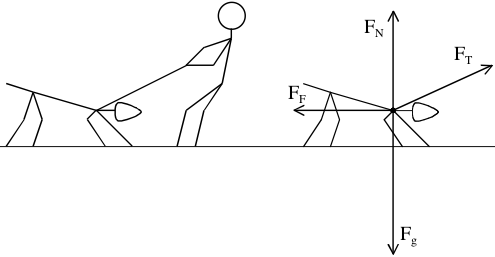
So, for example, consider the situation above, where the man is tring to pull the dog forward with an angled leash. The vertical part of the leash force, plus the normal force, will balance gravity, the only downward force. So, the normal force is less than what it would be if the dog were just standing there, and thus the friction force is less as well.

This doesn't mean the person will have any easier a time of it, however. He is now not just exerting enough force to pull the dog forward, but also is having to pull the dog partway off the ground. A lot of the force he is exerting is "wasted" on just lifting. This is one reason why the dog lowers its head to resist better (the other reason is about leverage: its front feet will be planted more effectively if they are roughly in line with where the force is coming from, just as, when you want to push a heavy box, it is easier to crouch down and push it from near the middle rather than from the top).

Activity: Friction Lab 2 (pdf) (10 pts, 11/20/06)
(One of the hardest things to understand in a force diagram is that the normal force does not always equal the gravity force. If I am pulling up on an object, the normal force will be lessened, until I finally take on all the weight of the object and it lifts off the ground. Similarly, if I am pressing down on an object, its normal force grows, since the normal force must balance my applied force as well as the gravity force)


Homework: Balancing Forces 2 (pdf) (Due: 11/21/06)

2.4. Review of the force types we know so far

At this point, you should be able to look at any situation, identify what forces might be acting on an object, and do what it takes to measure those forces. You should also know how to find some values related to forces:
  1. The mass of any object, related to the weight.
  2. The acceleration of an object, which is related to net force and mass.
  3. The coefficient of friction wherever there is a friction force.
There are five different force types that you need to be able to think about. Each one has very specific rules that determine how strong it is and in what direction it points. For example, tension, normal, and friction forces will all grow larger to try to oppose any other forces, but friction has a limit to how big it can become.
ForceSymbolWhat is it? When it is there?Direction is...Size is...
WeightAnything on Earth is pulled downwards by Earth's gravity.Straight down.The object's weight, which doesn't change.
NormalSolid objects don't like other solid objects to try to go through them. Any time two objects are in contact, they push against each other.Perpendicular to the surface.Enough to balance force into surface.
TensionPresent whenever a rope or string exerts a force on something.Along the string.Any strength, same at both ends of rope.
Friction
When two surfaces are pressed against one another, friction resists them trying to slip.Opposing the force or movement.μFN (μ is different for every pair of surfaces)
Applied
An "applied force" just means you're pushing something.Any direction.Any strength.

Homework: Force Diagrams Review (pdf) (Due: 11/15/06)

3. Exerting a force on any object makes it push back on you

3.1. Force diagrams for multiple objects

When we talked about what direction a force acts in, we said things like that a normal force always pushes away from where two objects are in contact, and a tension force always pulls along the rope or string. In both these cases, there are more than one objects involved, and each is experiencing a force.

If there are several objects in a situation, and I want to understand what is happening to each of them, I can draw an independent force diagram for each object. We call this a free body diagram. Take a look at the situation below, where I have draw a free body diagram for each of three blocks that are stacked on top of each other.

Here, the top box experiences just what any box on a table would feel: a gravity force pulling it down, and a normal force from the second box, pushing it up. The second box, however, has the normal force of the top box pushing down on it; this means that, in order for the forces on it to balance, there must be twice as much normal force pushing up from the block under it. We could think of this as being because the bottom box has to support both of the top two. The bottom box, in turn, has the weight of two boxes pressing down on it, in addition to its own weight, so the normal force on it from the table must be three times the weight of a box.

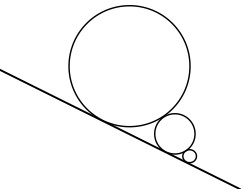
This is a slightly more complicated example. Look through it and try to figure out where all those forces come from.

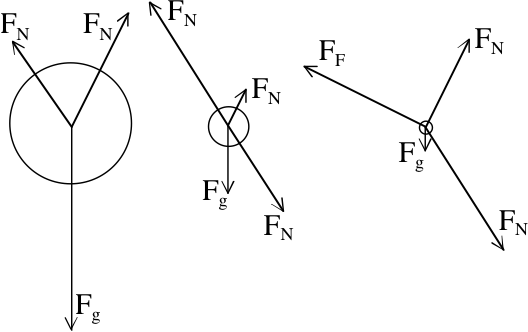
Three forces that should be easiy to explain are the gravity force on each ball. As we would expect, the biggest ball has the most weight.

We can also see the normal force from the ramp on each ball. This is the one that goes up and to the right. You can check and see that it is perpendicular to the ramp, and that it points in the direction that is opposite where each ball contacts the ramp.

The balls also exert normal forces on each other, just like in the stack example. If you circle the points where each pair of balls touch, you will note that each ball has a vector pointing away from that point.

Finally, the bottom ball has a friction force actng on it. Where does this come from? Friction always has to be along a surface touching the object; the fricton vector will be perpendicular to the normal vector from that surface. In this case, the friction is from the ramp. This friction force is what is responsible for supporting the whole stack of balls.

Notic that the friction force is bigger than the normal force: μ is greater than 1. Maybe the bottom ball is really a wad of chewing gum.

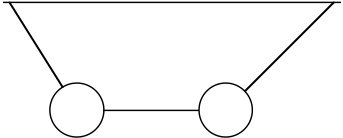
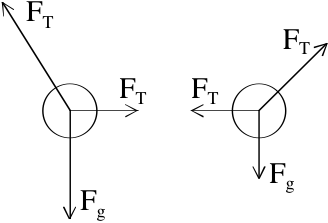
Here's one last situation with its free body diagram. Notice that each ball has its own weight and its own tension force toward the outside, but the tension force toward the inside must be the same, because it's the same rope and it has a certain amount of tension in it. The direction of the two forces are opposite, because tension always points along the rope.

3.2. Newton's Third Law

In the examples above, we see that force really comes from two objects interacting; no force just acts on one object alone. When two objects are touching, each feels an equal normal force pushing them apart. The two objects on either side of a rope are pulled toward each other with equal forces. The friction force that I exert backwards on the groun, when I start running, corresponds to a forward force that gets me moving, and I had better hope that the ground isn't ice, or a loose rug, or something that can't give that much friction. Even the gravity force on me from the Earth is matched by an equal force that I exert upwards on the earth.

So, what we see is that force comes from an interaction between two objects, and both objects will always feel a force. The direction of the force on each object will be the opposite of the other, but the strength of the force will be exactly the same. We can think of this pair of forces as being part of the same event: molecules in the surface resisting being squished (), a rope fighting against stretching (), two surfaces trying to grab old of each other ().

Newton made note of this fact in his third law of motion:
All forces exist as part of a pair of forces acting on two different objects. If the force on A from B is , the force on B from A will be -: a force of the same strength in the opposite direction.

This law is sometimes stated as "For every action, there is an equal and opposite reaction."

Homework: Free Body Diagrams (pdf) (Due: 11/28/06)

3.3. Reassembling a situation using the force diagram of each object

I particularly enjoy the parts of physics, like looking at a motion graph for multiple objects and determining what story it tells, that involve a bit of detective work and creative thinking. We occasionally have to do a similar sort of thing when dealing with forces: we may be presented with a force diagram for one or several objects, and want to figure out what is happening to those objects.

Activity: Force Puzzles (pdf) (11/28/06)
(Given the free body diagrams for several objects, determine how they must be interacting with each other by using Newton's third law and identifying force pairs)

4. Review

There are three basic questions that you need to be able to answer about Force:

What forces act on this object?//Put up pictures of the direction of forces
How strong are each of those forces?
What do those forces do to the object?
Homework: Force Review (pdf) (Due: 11/29/06)